Beyond making videos, images and music, FilmMovie Studio can do something unexpected: run real Python right on your computer to do actual file work. It merges hundreds of CSV rows, renames a whole folder of photos, pulls totals out of PDF invoices or converts an XLSX into a clean report — you describe it all in plain language, the app writes a short block of Python, and you approve each step before it runs. The feature uses libraries like openpyxl, python-docx and pdfplumber, and only runs when Automation is enabled in Settings. In this guide we'll run the whole loop: attach files, describe the task with /automation, review and approve the generated code, and collect the finished output locally.
What you'll need
- FilmMovie Studio installed (macOS or Windows).
- Automation enabled in Settings (Settings → Automation).
- The files you want to work with — e.g. a few CSV/XLSX spreadsheets, a folder of images or PDF documents.
Step by step
- 1
Enable Automation and open the Workspace
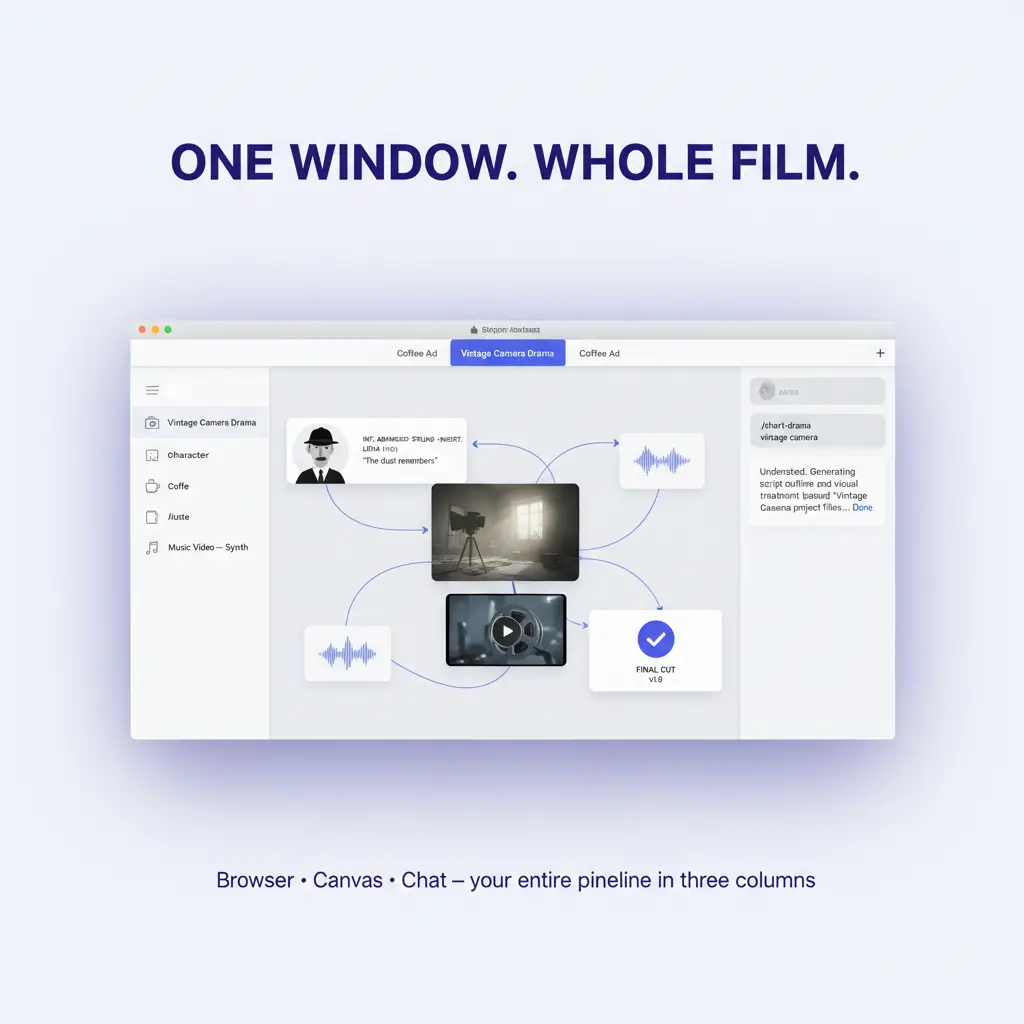
In Settings (Settings → Automation), turn on Automation — without it the app refuses to run Python. Then open or create a project from the Launchpad; the Workspace opens with the canvas and chat.
Film Movie StudioRenderFrom prompt to filmNew projectLaunchpadHubAll projectsRecent project 1
 project 2
 project 3Settings
Film Movie Studio
A new way to create media with AI
Describe what you want to create…
SkillsModelsType / to explore AI skills
Short DramaE-commerceMusic VideoGamesDocumentaryTip: The project folder is also Python's working directory — anything a script creates lands right here. - 2
Attach the files you want to process
Drag your CSV/XLSX spreadsheets, PDFs or images straight onto the canvas, or add them with the attachment button in chat. Each file is copied into the project folder (assets), so Python can reach them by a simple filename.
Film Movie StudioRenderFrom prompt to filmNew projectFilesframe_1.pngframe_2.png frame_3.png
 frame_4.png
 frame_5.png
Drag an image here, or click to upload
reference.png - 3
Describe the task with /automation
In chat, type /automation and describe in your own words what needs doing — e.g. "merge all attached CSVs into one table and add a month column", "rename the photos by their EXIF date", or "pull the invoice number and total from the PDF invoices into an XLSX".
Film Movie StudioRenderFrom prompt to filmNew projectFilesframe_1.pngframe_2.pngframe_3.pngframe_4.pngframe_5.pngframe_6.pngDrag an image here, or click to upload
reference.pngTip: Describe the result, not the code. Mention both the input and output format (CSV, XLSX, DOCX) so the app picks the right library. - 4
Review the generated Python step
The app writes a short block of Python and shows it on an approval card with a one-sentence "why" (what the block does). Read the code — it typically uses openpyxl for Excel, python-docx for Word, pdfplumber to read PDFs, or the standard modules for CSV and files.
Film Movie StudioRenderFrom prompt to filmNew projectFilesframe_1.pngframe_2.pngframe_3.png60%promptframe_01.pngGenerating… 42%Remixframe_02.pngGenerating… 68%Remixframe_03.pngGenerating… 55%RemixoutputTip: Each task is a small, readable step. If something looks off, deny it and say in chat what to change — don't retry the same thing. - 5
Approve the run and watch the output
Click "Approve" and the block runs on your computer. The app shows you the output (stdout) and any errors. State persists between steps, so the task builds up gradually — first the load, then the transform, finally the save.
Film Movie StudioRenderFrom prompt to filmNew projectFilesframe_1.pngframe_2.pngframe_3.pngframe_4.png60%promptframe_01.pngRemixframe_02.pngRemixframe_03.pngRemixframe_04.pngGenerating… 80%Remixoutput - 6
Refine with follow-up steps
If something needs adjusting — a different date format, an extra column, a row filter — say so in chat and the app sends another small block for approval. This is how you finish the task step by step without writing any code yourself.
Film Movie StudioRenderFrom prompt to filmNew projectFilesframe_1.pngframe_2.pngframe_3.pngframe_4.pngframe_5.pngframe_01.pngRemixVariationsAdd to timelineFullscreenDeleteTip: For larger batches, try the step on one or two files first, then let it loose on the whole folder. - 7
Collect the finished files locally
When it's done, the script saves the result into the project folder and the app adds it as a card on the canvas via fms.attach. You'll find the file (e.g. report.xlsx or a folder of renamed photos) right on your disk in the project's assets folder.
Film Movie StudioRenderFrom prompt to filmNew projectFilesframe_1.pngframe_2.pngframe_3.pngframe_4.pngframe_5.pngframe_6.pngDrag an image here, or click to upload
reference.pngTip: Outputs are plain files on your disk — open them straight in Excel or Word or pass them on; no extra export step needed.
What you get
Boring, manual file work became a few-minute conversation: you attached spreadsheets or documents, described the task with /automation, approved a few small blocks of Python, and your finished files sit locally in the project folder. The same pattern — attach → describe → review → approve → collect — handles merging CSVs, batch-renaming, extracting fields from PDFs and converting between formats.
Pro tips
- For destructive steps (deleting or overwriting your original files) the app first explains what it will do and waits for a clear "yes" — back up your originals first to be safe.
- You approve each Python block separately; if you deny one, the app won't retry the same thing but asks what to change.
- Mention specific libraries or formats (openpyxl, python-docx, pdfplumber, CSV vs. XLSX) when you want to be sure how the output is produced.
Try it yourself
FilmMovie Studio is a desktop app that walks you from idea to finished export. Download it and start creating.
Get FilmMovie Studio